This is the latest I’ve ever been on a week in review. It is fully next week. But here’s what happened. First, my game jam scores:
Not bad! I hoped for a little higher, and I only got 8 ratings lol, but I am proud. I’ve learned a lot about Blender modeling since finishing the jam, now that I know what I don’t know, and I’m eager to revise this soon and bring it closer to how it is in my head. But not yet…
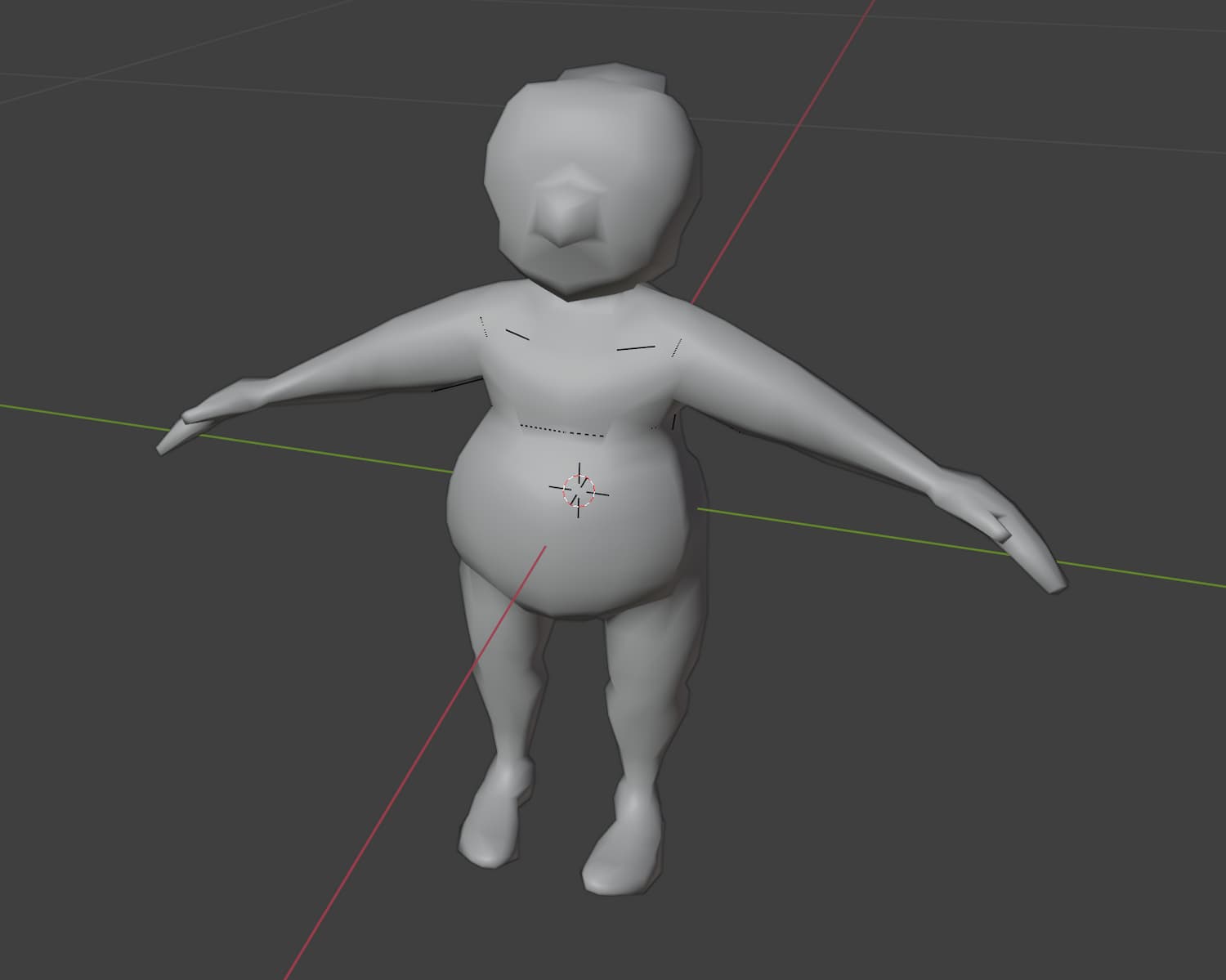
As I mentioned last time, it is now time for Halloween. I’m keeping and building on last year’s jungle theme, and I knew I specifically wanted to add some small humanoid animatronics. I just spent four days living in Blender and my muscle memory was still sharp, so I dug through my bookmarks and learned how to export a 3D model as a papercraft template for printing and assembling. (Turns out that “export to paper” is a built-in add-on, you’ve just gotta enable it.) So I modeled a guy:
…then decided I should start small with just the hand of that guy:
A success! I rushed it a little and the quality is not perfect, but this is all meant to be a first layer that I can refine with paper mache and air-dry clay. For that it’s ideal, faster and more precise than what I might be able to do by hand with wire and aluminum foil or whatever, especially considering I want a lot of these and that I want the process to be repeatable and/or delegatable, someday.
Holding this hand in my hand was illuminating for scale, also. I arbitrarily decided these people should be about 18” tall, and these hands are so small that I can get away with just making them from flat sheets of foam. But now that I’ve seen this work, I decided I should try making a whole body. And I did!
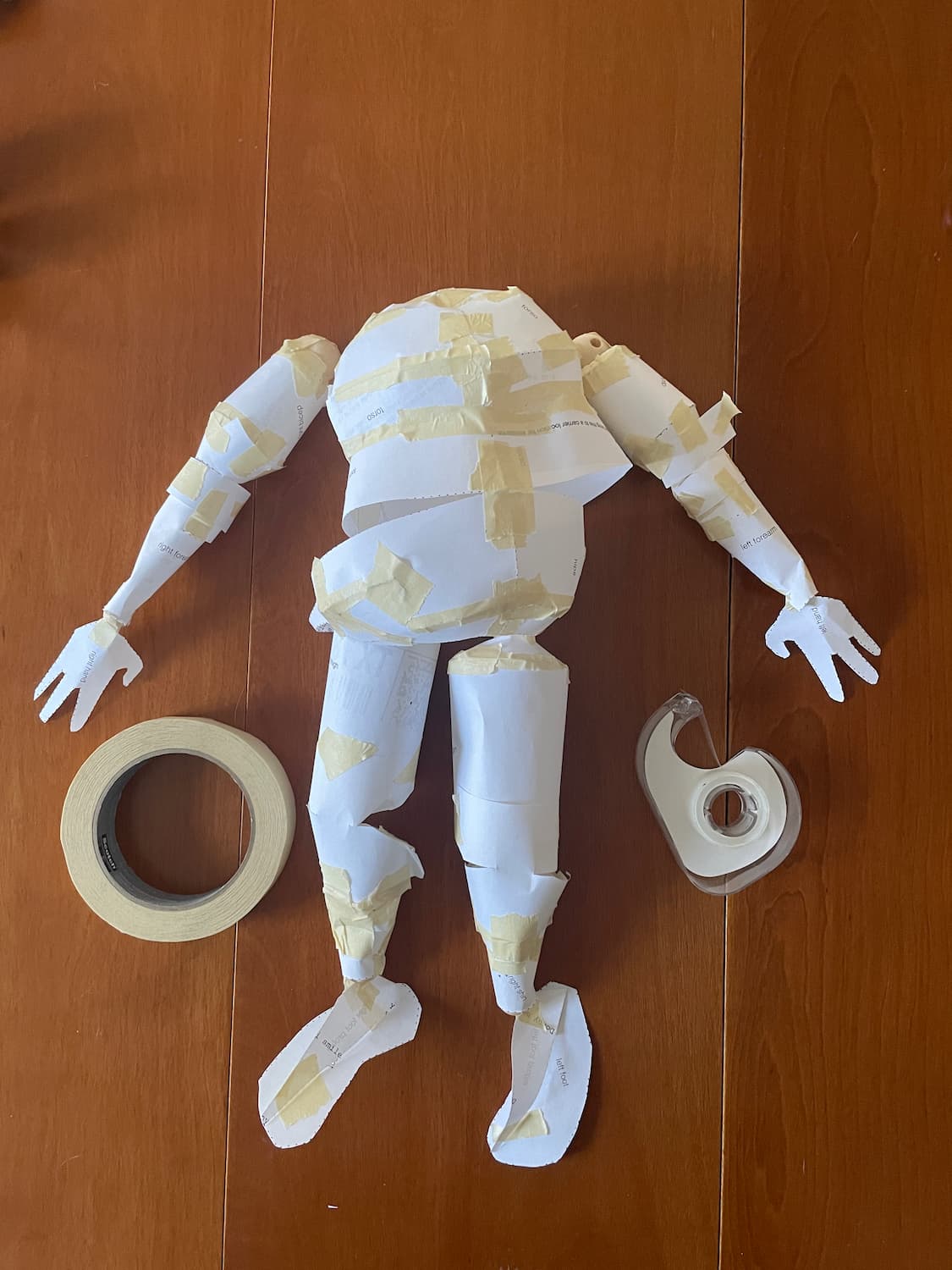
This is all regular copy paper taped together, so it’s fragile, but it proves the concept beautifully. I tried doing something similar that was much harder and took way more work and didn’t really look good…nearly ten years ago. I made a lot of creatures with the technique I outlined in that blog post but they never went anywhere because they all kinda looked like shit, even if I did get better at it. The relative failure of that is what drove me to make flat things out of plywood, which is where I’ve been ever since. Seeing what I can do with this Blender-export technique and how close the physical thing is to the digital thing is a huge breakthrough and—not to sound like a YouTube clickbait title—but I think it’s going to change how I approach this kind of work forever.
I spent a couple days thinking about how an armature inside this shell should function. If the armature is strong enough, these paper shapes just need to support their own weight. I tried a few things and ended up here:
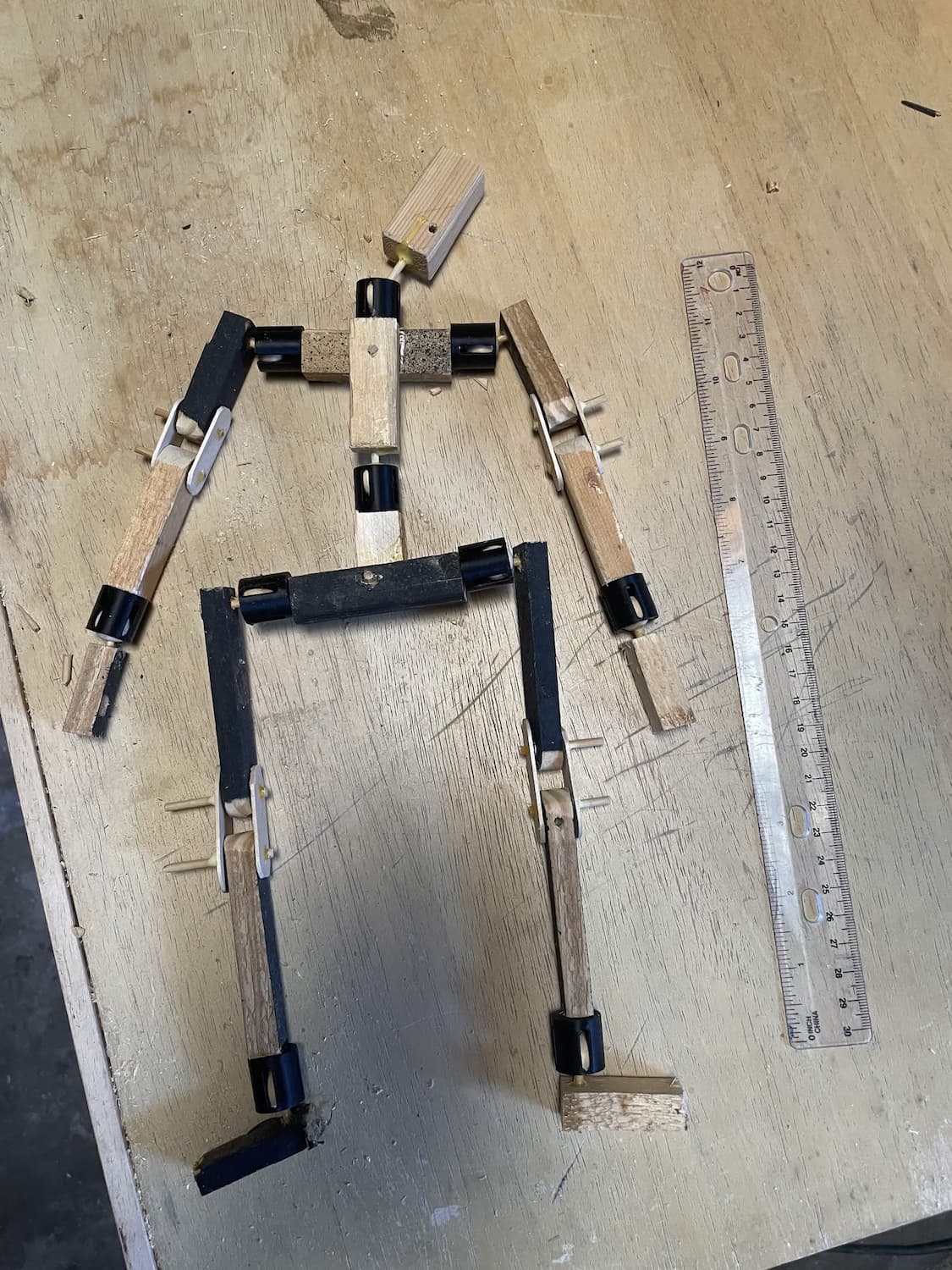
The long bits are all 3/4”-ish square wood dowels (in this case cut from scrap, hence the mismatched paint job). They’re connected by two kinds of joints. Elbows and knees are a double-jointed hinge made of craft sticks (like popsicle sticks) and bamboo skewers. Shoulders and hips and necks and wrists and ankles and torsos are wooden beads on more skewers that mate with a custom socket I modeled and 3D printed. This kind of precise, specific, high-quantity part is the perfect example for why I have a 3D printer. It took a couple iterations to get the fit just right, but then it took no effort at all to make like thirty of them. I had a couple ideas for how to go about this using other techniques, but they all would have been faulty and very time-consuming.
I considered 3D-printing more of the armature, which would have saved even more time—this still took like an hour or two to assemble—but this version is extremely sturdy and durable. Did you know that wood glue is stronger than wood?
I wrapped the paper shells around this armature and ended up with this:
I’m so extremely proud of this!!! Imagine that there's a servo pushing that stick up and down instead of my hand. This character is playing a clarinet and will be joined by two others, one on the washtub bass and one on the triangle. I now feel like I can design anything in da computer and then confidently bring it into the real world, at any scale, with repeatable and predictable steps. This is fucking amazing.
I’ve gone a lot farther since this but this is a review of last week! I’ll bring you up to speed on Wednesday to get back on schedule. There’s a lot more! Exclamation points!!!